Egyptian roots. Greek imagination. Roman ambition.
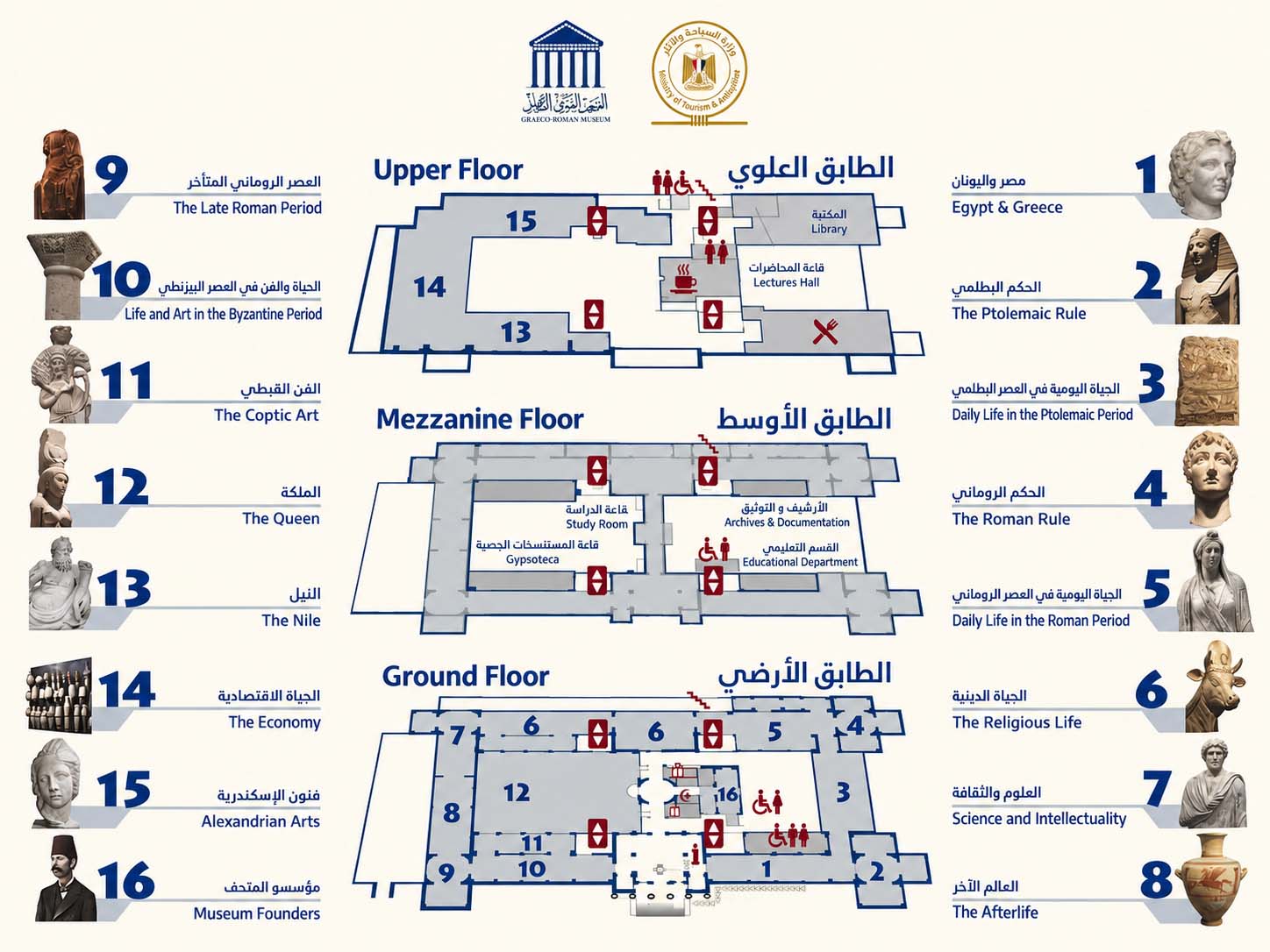
In Alexandria, cultures met and a remarkable story unfolded. The Graeco-Roman Museum brings you into the lives, beliefs and artistry of Egypt’s Greek and Roman eras.
Founded in 1892 to safeguard Alexandria’s antiquities, the museum moved into its purpose-built neoclassical home in 1895. Today, its galleries invite you to look closely at a city shaped by many worlds.
A monumental queen. A familiar face. A story held in stone. A few encounters to begin your visit.
THE CENTRAL COURTYARD
I.
An extraordinary encounter
The queen of the courtyard.
Colossal statue of a Ptolemaic queen
Granite · Ptolemaic period · Alexandria
Recovered from the sea near ancient Pharos in 1963, this extraordinary figure now rises above the museum courtyard. The museum identifies her as probably Arsinoë II: a queen presented with the attributes of a goddess.
Look up at the crown, then at the knot in her garment — details that connect royal power with the goddess Isis.
The museum’s portrait shows Cleopatra with a royal diadem. Look closely at the headdress: royal imagery becomes a language of power.
02
Sandstone · 40–30 BC · Dendera
The sun and the moon.
Alexander Helios and Cleopatra Selene
A boy and a girl wear the sun and moon discs. These details suggest the children of Cleopatra VII and Marcus Antonius, their identities expressed through celestial symbols.
03
Basalt · Roman period
A sacred presence.
The Apis bull
In the form of a bull, Apis embodied a sacred presence. This dark basalt sculpture is a striking encounter with the religious life of ancient Egypt.
Your museum companion
More than meets the eye.
Introducing the Graeco-Roman Museum Pocket Guide. A mobile interactive experience designed to bring you closer to the objects, people and stories around you.
01
Follow your curiosity
Discover the stories behind objects that catch your eye.
02
Look a little closer
Connect a face, a symbol or a detail with the world it came from.
03
Keep discovery in your pocket
Open the experience on your own phone while visiting the museum.